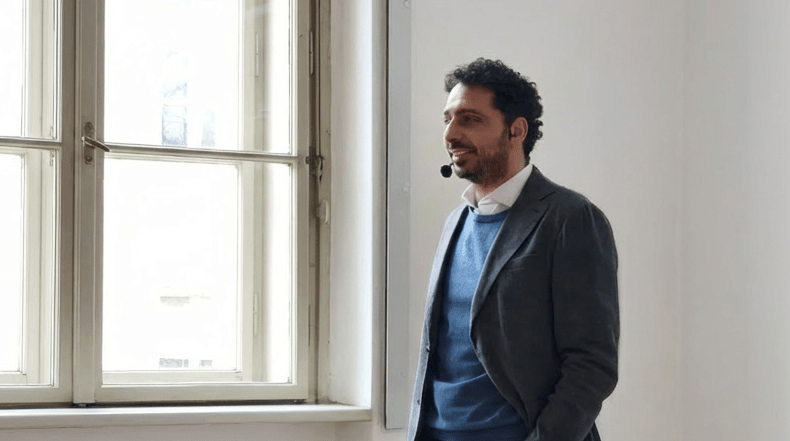
Between February 16 and February 20, 2026, the Faculty of Science at Charles University had the distinct pleasure of hosting Dr. Eng. Vito Tagarelli, who joined us from the Polytechnic University of Bari in Italy. His five-day visit, generously supported by the Charles University Mobility Fund and the Faculty Internationalisation Fund, was packed with engaging academic activities, insightful lectures, and highly productive discussions aimed at shaping future international research collaborations.
Dr. Tagarelli earned his PhD in 2019, with a portion of his research conducted at the Universitat Politècnica de Catalunya in Barcelona. His expertise lies heavily in thermo-hydro-mechanical numerical modelling, the diagnosis of landslide processes, and early warning systems for weather-induced landslides.
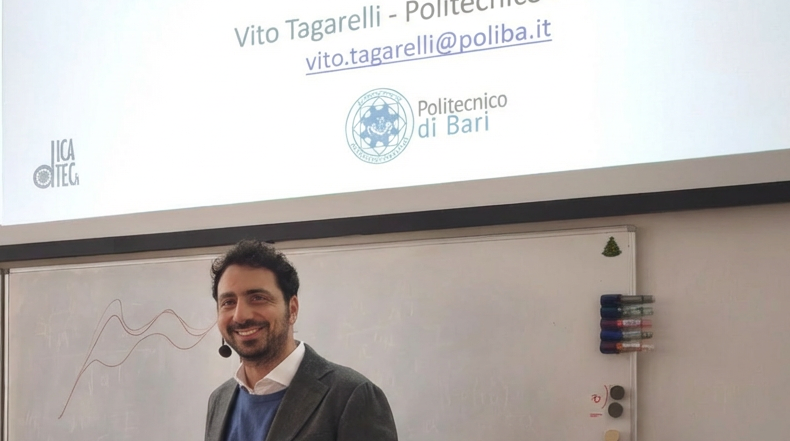
On Monday, February 16, he delivered a captivating seminar in the Mineralogical Auditorium at Albertov 6. The presentation was titled “The soil–vegetation–atmosphere interaction in a clayey slope: implications for nature-based landslide mitigation”. During this session, he explained how soil-vegetation-atmosphere (SVA) interaction is increasingly recognized within the geotechnical community as a frequent triggering factor for landslide reactivations in clayey slopes. Dr. Tagarelli detailed how thermodynamic, hydraulic, mechanical, and chemical processes within the SVA interaction impact both the gas and liquid mass balances in soil pores. These processes generate transient water seepage from the surface down to deeper levels, which subsequently alters available shear strengths and effective stresses over time, ultimately affecting slope stability.
To combat these issues, Dr. Tagarelli shared insights from a full-scale in-situ test site located at the toe of a deep active landslide mechanism. By seeding selected crops, researchers monitored the vegetation’s impact on the soil state alongside forcing atmospheric actions. The monitoring of this test site yielded insightful results, confirming that the root systems of selected vegetation have a distinctly non-negligible impact on both the soil state and its thermo-hydro-mechanical properties. These preliminary findings offer promising data that underscore the beneficial role vegetation can play in mitigating landslide risks.
Beyond this main seminar, Dr. Tagarelli also contributed directly to our educational programs. He delivered two guest lectures integrated into the 4EU+ courses of “Soil Mechanics II” and “Grand Challenges in Engineering Geology”. These lectures were well-attended by staff members, as well as students specializing in geophysics, hydrogeology, and engineering geology. Following the seminar, attendees engaged in a lively question-and-answer session, reflecting the high level of interest in his research.
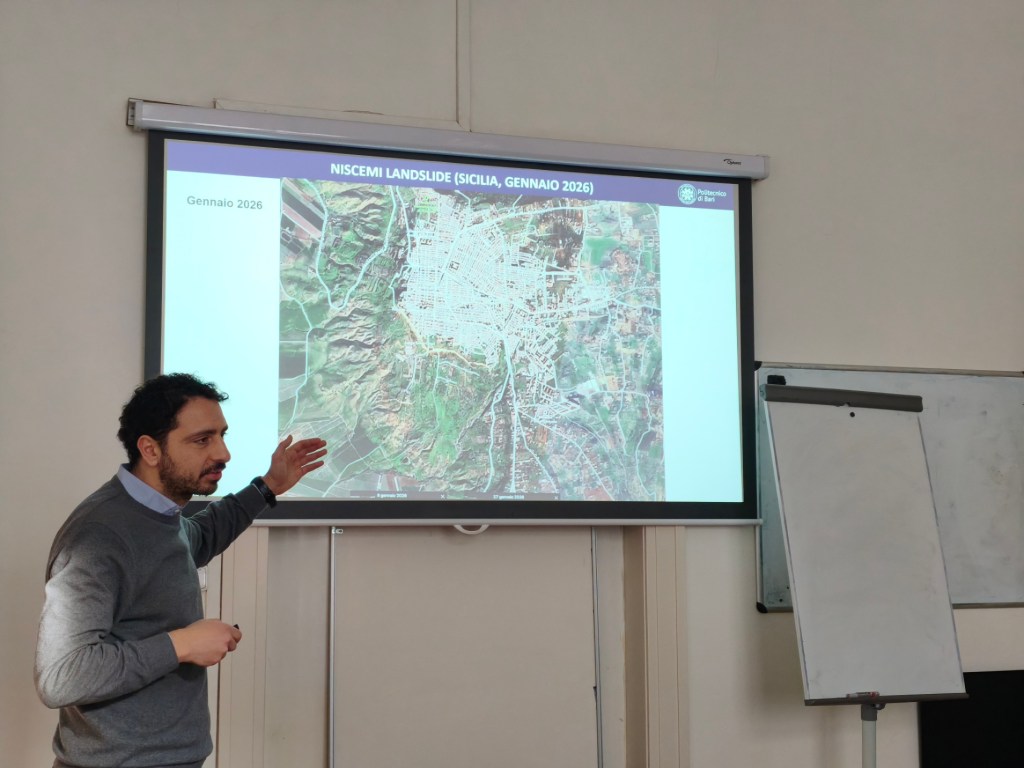
A significant portion of Dr. Tagarelli’s visit, hosted by Dr. Gianvito Scaringi, was dedicated to planning future initiatives. Key collaborative outcomes from the week included discussions on formal collaboration through a COST Action which involves the RootS network focusing on vegetated slopes, planning for a new ERASMUS+ agreement to facilitate future mobility for both staff and students between our institutions, strategic planning for a research proposal concerning SVA interactions and multiphysical couplings in landslides, and suggestions for enhancing our study curricula to provide engineering geology students with a stronger background in geomechanics and soil mechanics.
This mobility initiative successfully strengthened the ties between Charles University and the Polytechnic University of Bari. The resulting partnerships and planned projects promise to elevate the prestige, attractiveness, and research excellence of our institution for years to come.
 The Geohazards Group