Geological hazards are usually discussed in terms of impact severity and recurrence intervals. However, on March 20, 2026, our “Grand Challenges in Engineering Geology” course took a fascinating detour into the human side of the rubble.
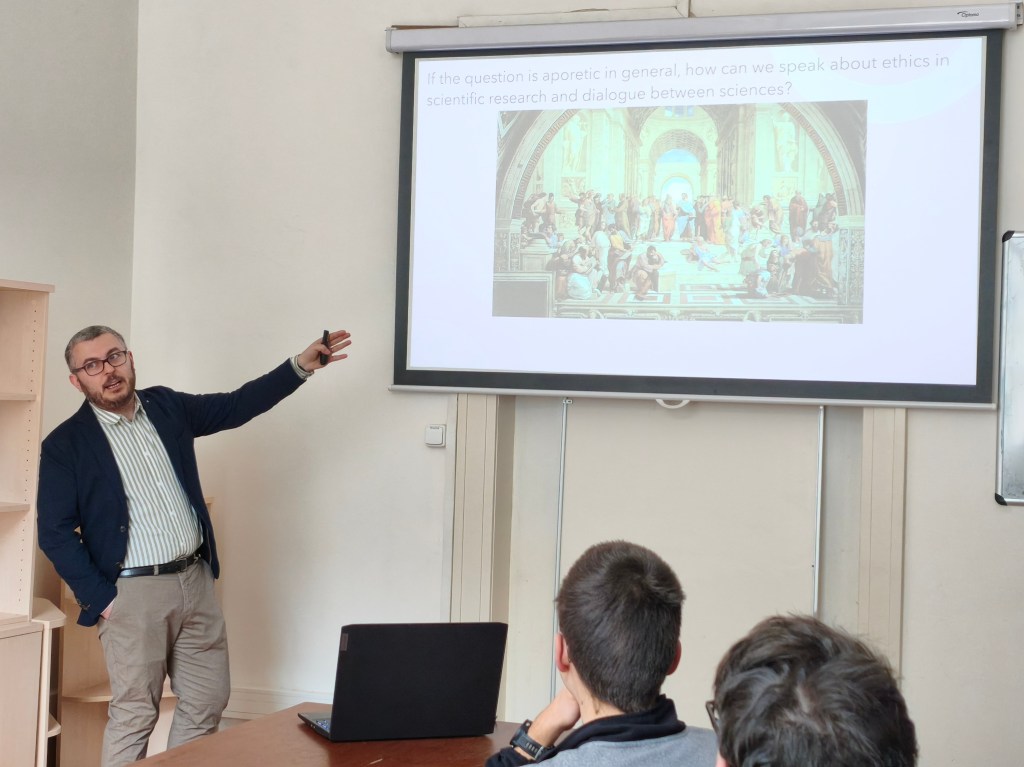
The Faculty of Science was thrilled to host Dr. Emanuele Lacca, Ph.D., applied philosopher from the University of South Bohemia, for a seminar titled: “If you see it, don’t run away. Communication and Risk Assessment for Natural Disasters”. The event brought together a diverse crowd of students and staff to bridge the gap between “hard” and “soft” sciences.
The bridge between data and people
Dr. Lacca’s core message was clear: while geologists and engineers are great at measuring what happens, the “soft” sciences (like ethics and sociology) are essential for determining how we tell the world about it.
Key takeaways from the discussion included:
- Ethics as a Foundation: Ethical scientific research isn’t just about following rules; it’s about building the trust and credibility required for the public to actually listen when an alarm sounds.
- The “What If…?” Power: These scenarios aren’t just “naive discussions” or simple data sets. They are actual planning tools that integrate spatial and time dimensions to help policymakers and the general public understand and prepare for early warnings.
- A Lesson from the Past: We looked back at Pliny the Elder and the eruption of Vesuvius, and the 1908 Messina earthquake, which reminds us that disasters always have social, political, and economic dimensions.
Why this matters for engineers
It’s easy to get lost in the math, but Dr. Lacca reminded us that the ultimate goal of risk assessment is an ethically sound communication system. By avoiding alarmism and focusing on individuals, we can turn a terrifying “natural” event into a managed social response.
The seminar concluded with a high-energy debate. Our students didn’t hold back, peppering Dr. Lacca with questions about how to balance scientific accuracy with the need for immediate public action. It turns out that “Grand Challenges” aren’t just about the earth moving—they’re about moving the people living on it.
 The Geohazards Group