
The Cauvery River is a crucial drainage system in Peninsular India, supporting the region’s agriculture and ecological systems. However, it remains poorly studied when it comes to long-term sediment dynamics.
This study presents the first comprehensive assessment of 45 years (1973–2018) of suspended sediment trends across the Cauvery basin, combining non-parametric methods (Mann-Kendall test, Pettitt test, double-mass curves), disentangling drivers of trends and assessing downstream impacts.
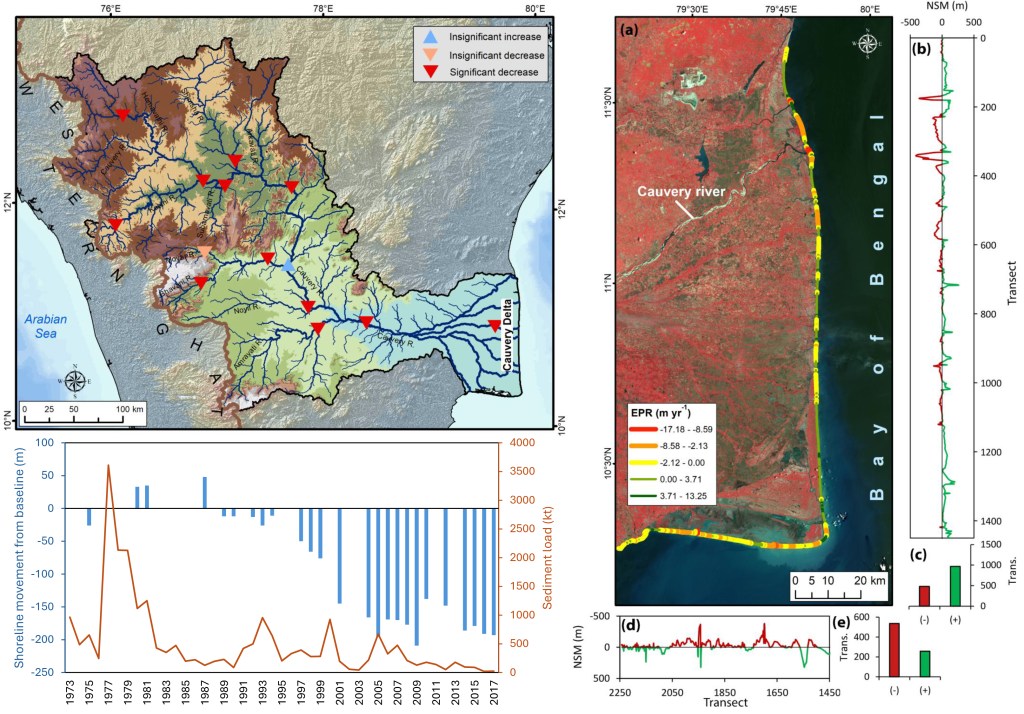
Results indicate alarming consistent sediment reductions at 13 of 14 stations, with 12 showing statistical significance (p < 0.05) over the past two decades. The sharpest decline occurred in the middle reach (Biligundulu: 33.79 × 10³ t yr−1), followed by the terminal station Musiri (13.73 × 10³ t yr−1). From 2000 to 2018, the average sediment load at Musiri decreased by 68 %, while upstream tributaries Hemavati and Shimsha showed 71 % and 76 % decline, respectively. These declines exceeded those reported in larger rivers such as the Godavari or Krishna. Importantly, long-term rainfall showed no significant trends, ruling out climate as a primary driver. Change-point analysis identified abrupt sediment reductions during the mid-1990s to early 2000s, coinciding with NDVI-linked vegetation health recovery post-1990 and dam construction peaks. Land-use shifts (1985–2005) led to a decrease in forest and agricultural areas by 8 % and 3.5 %, respectively, while built-up areas expanded by 140 %, likely leading to an initial increase in sediment load.
Sediment starvation caused severe coastal erosion in the Cauvery delta, with over 300 m of retreat at the estuary and localised recession exceeding 500 m. Previously stable lagoons are now experiencing intensified erosion and reflecting deltaic vulnerability. These findings provide a pivotal baseline for sediment-starved deltas in India, urging strategic basin management to mitigate irreversible submersion risks under rising sea level.
Das, Jadhav, Roy, Scaringi (2025), CATENA. Full paper here.
 The Geohazards Group