
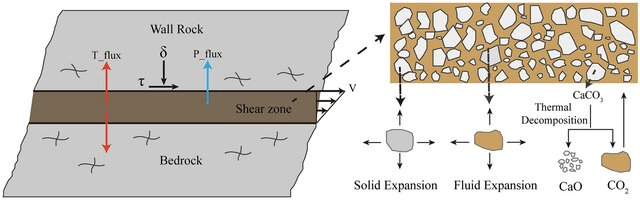
Thermochemical pressurization is a possible weakening mechanism that could explain the hypermobility of large landslides in carbonate rock. However, the factors controlling the efficiency of this mechanism in generating hypermobility have not been elucidated. Here, we use mass and energy conservation equations—accounting for the thermal decomposition of carbonate and a thermoporoelastic mechanism—to evaluate the efficiency of thermochemical pressurization in the 2009 Jiweishan rockslide event in China. We consider distinct permeability functions for the shear zone and the rock wall, controlled by distinct mechanical processes, and explore the sensitivity of the model to changes in the values of the key parameters. We evaluate that a combination of pore pressure increase and the endothermic nature of the chemical reaction may effectively limit frictional heating. We observe that the increase in pore pressure is controlled by the permeability of the rock wall rather than by that of the shear zone and its thickness. We also find that the permeability of the damaged rock wall is the key factor controlling the energy ratio—a measure of efficiency. We conclude that the comparatively low velocity and small thickness of the sliding body, and the relatively high permeability of the formation in which the Jiweishan landslide developed may have limited the effect of thermal decomposition.
Deng, Fan, Scaringi, Wang, He (2023), Rock Mechanics and Rock Engineering.
The full text is available here.
 The Geohazards Group