
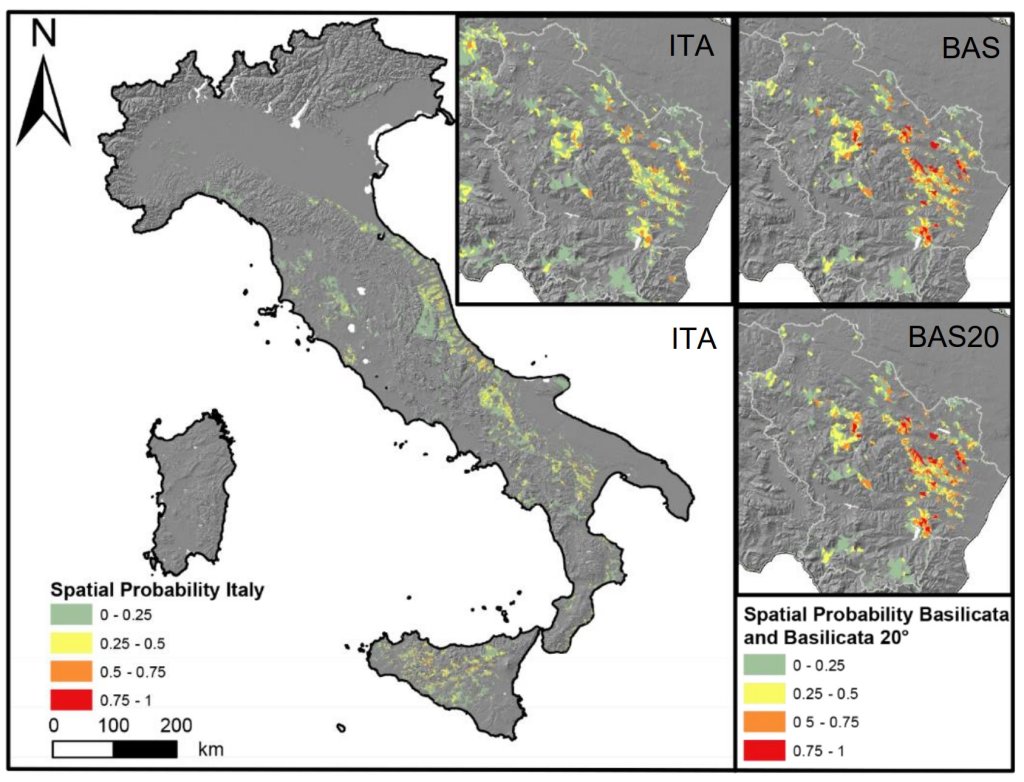
Among the factors controlling the stability of slopes, the role of temperature remains poorly understood, especially in temperate climates. Experiments reveal the coupled thermo-hydro-mechanical (THM) nature of clay behaviours; however, field evidence of thermally-induced landslides is scarce. The complexity of THM processes hinders the construction of a temperature-related variable, usable in modelling at multiple scales. We conducted spatial modelling for areas in Italy featuring shallow clay landslides moving on gentle slopes. We used the Italian National Inventory (IFFI), which discriminates among different landslide types. We employed a slope unit-based Generalised Additive Model (GAM) and utilised Land Surface Temperature (LST) data from MODIS, accessible in Google Earth Engine. We found a positive correlation between landslide occurrence and LST in Southern Italy, where creep/shallow phenomena are common. This aligns with the known decline in soil/water viscosity as temperature rises, resulting in enhanced creep rates.
Loche, Scaringi (2024), Environmental Modelling & Software.
The full text is available here.
Data and code can be found in our repository.
 The Geohazards Group