
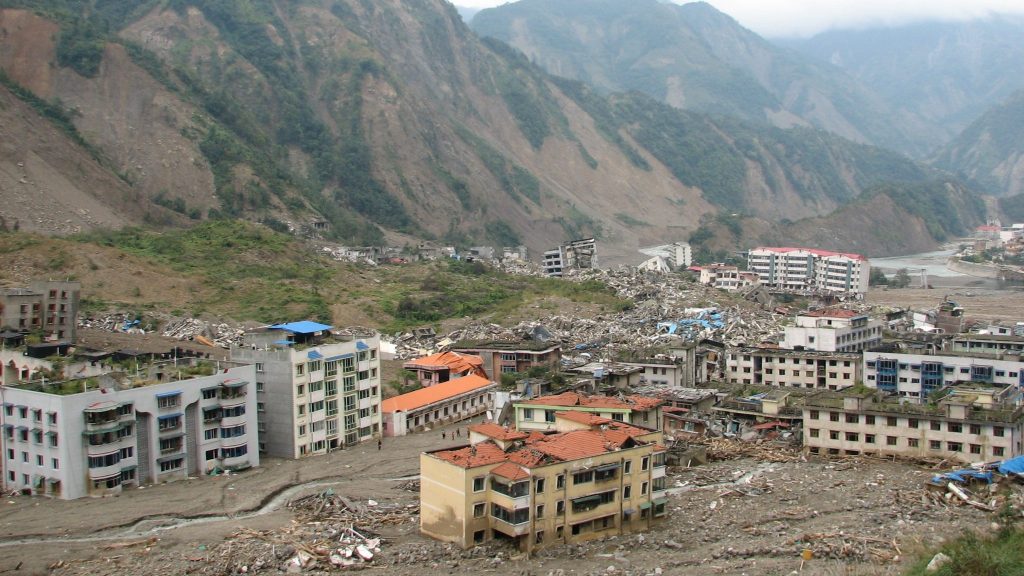
Strong earthquakes in mountainous regions trigger chains of events that modify mountain landscapes over days, years, and millennia.
Earthquake shaking can cause many tens of thousands of landslides on steep mountain slopes. Some of these sudden slope failures can block rivers and form temporary lakes that can later collapse and cause huge floods. Other landslides move more slowly, in some cases in a stop-start fashion during heavy rains or earthquake aftershocks. Debris from these landslides can clog channels, and during heavy rainfall, the debris can be transported downstream for many kilometers with catastrophic consequences.
New landslides tend to happen more frequently than usual for months to years following an earthquake because the strong ground shaking has fractured and weakened the slopes. Other effects of large earthquakes can last, in various forms, over geologic time scales.
Over the past two decades, our understanding of these issues has advanced because of the detailed study of the 1999 Chi-Chi earthquake in Taiwan and the 2008 Wenchuan earthquake in China.
In this extensive review, we compiled and discussed the results of research on these and other earthquakes and explain what we have learned, what we still need to know, and where we should direct future studies.
Fan, Scaringi, Korup, West, van Westen, Tanyas, Hovius, et al. (2019), Reviews of Geophysics.
The full text is available here.
 The Geohazards Group