
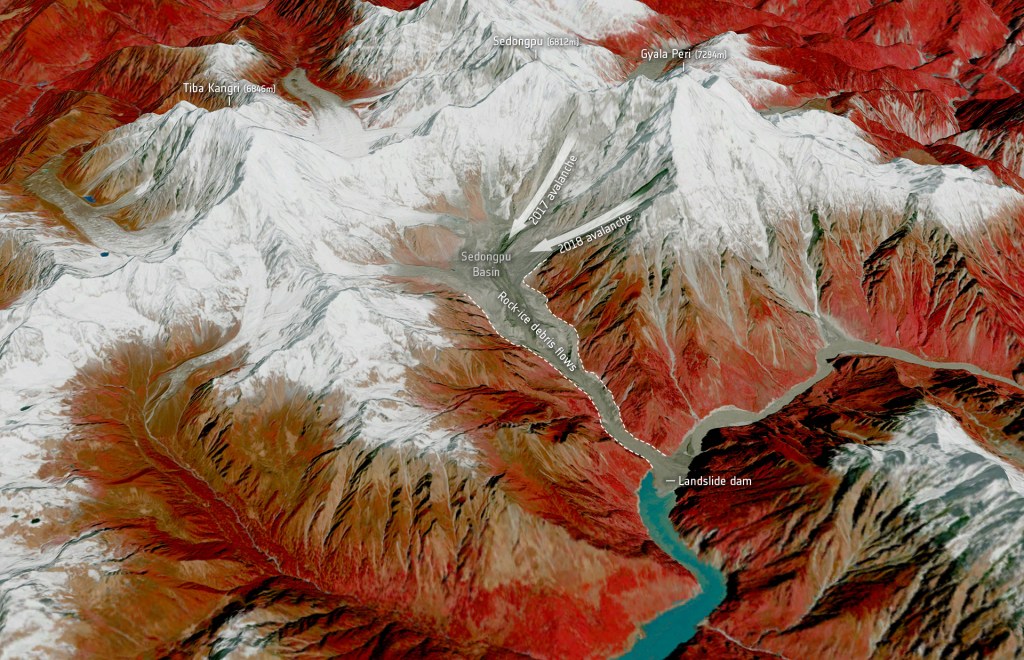
In this paper, we focused our attention on the increasingly frequent glacier-rock avalanches (GRAs) in Sedongpu gully in the eastern Himalayas. These events, triggered by the detachment of both glacier and rock materials, blocked the course of the Yarlung Zangbo River (the upper stream of the Brahmaputra in Tibet, China) repeatedly.
To grasp the patterns of these GRAs in space and time and itentify the factors influencing them, we analysed remote sensing images and produced high-resolution digital surface models.
At least eight GRAs, originating from the same source areas, occurred in the past decades: one in 1974, one in 2014, and six between 2017 and 2018. The GRAs that occurred since 2014 were responsible for the loss of over 70 million cubic metres of glacier and rock and over 150 million cubic metres of moraine deposits. Importantly, they caused an increase in the elevation of the basin outlet by more than a hundred metres.
Climate change-induced glacier retreat, steep topography, and a recent strong earthquake were found to be related to the occurrence of the recent GRAs, which resulted in the formation of a knickpoint in the Yarlung Zangbo River.
Li, Zhao, Scaringi, Lu, Huang (2022), Landslides.
The full text is available here.
 The Geohazards Group