
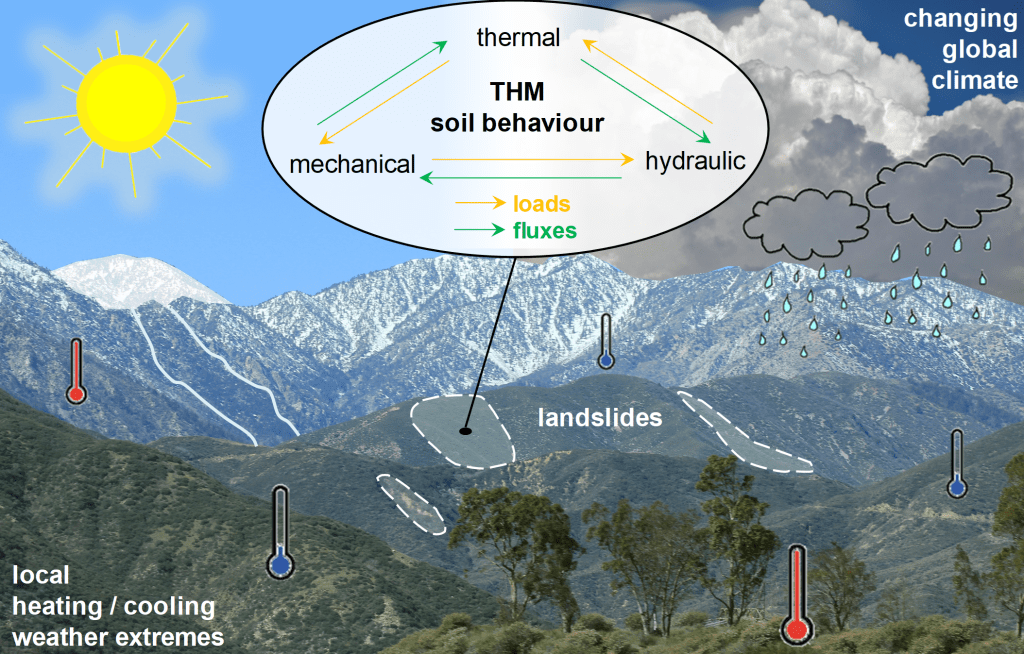
Landslide initiation and dynamics are approached with different methods according to the scale of investigation. Individual landslides are typically described by studying the mechanical response to the hydrological input resulting from atmosphere-soil interaction. As the scale increases, physically-based models are gradually simplified, and finally give way to statistical approaches.
At any scale, while the role of temperature in controlling evapotranspiration and thus the hydrological balance is well recognised, direct thermo-mechanical couplings are systematically neglected unless changes in water phase are involved. This contrasts with abundant experimental evidence of a fully-coupled thermo-hydro-mechanical behaviour of most geomaterials, even in ranges of temperature naturally experienced at the ground surface or in the near subsurface.
In this article, we reviewed temperature-dependent processes that are potentially relevant to slope stability, focusing in particular on clayey slopes in temperate and warm regions.
We hypothesised that temperature fluctuations and trends induced by climate change may exert, in short to long terms, a hydro-mechanical forcing on slopes (by altering permeability, water retention capacity, compressibility, shear strength).
Together with other known effects (such as altered precipitation patterns and changes in land use), they could affect landslide activity and the distribution and frequency of slope failures.
To verify this hypothesis across the scales, systematic field monitoring of temperature-related variables is necessary, together with geostatistical analyses entailing thermal remote sensing products. At the same time, fully-coupled approaches need to be upscaled to permit physically-based catchment- or regional-scale studies accounting for appropriate temperature-related variables and the inherent heterogeneity in materials and boundary conditions.
Scaringi, Loche (2022), Geomorphology.
The full text is available here.
 The Geohazards Group