Evaluating the likelihood that a landslide will strike at a specific location sometime in the near future is a complex task.
It is a task that is performed over a rather large area (tens to hundreds of square kilometers and sometimes more) by seeking correlations among a number of potential controlling factors and the occurrence of landslides. These correlations are usually obtained by analyzing a large dataset of past events. Therefore, the temporal information (when did the landslide happen?) is normally neglected. One wants to collect as many data points as possible and compare them to a set of “static” maps containing information on the shape of the slopes, the path of the streams, the location of seismic faults, the average rainfall, and so on. This statistical study can tell more or less where (but not when) a new landslide will hit or an old landslide will move again depending on the patterns of the past events.
In other words: “The past is the key to the future”.
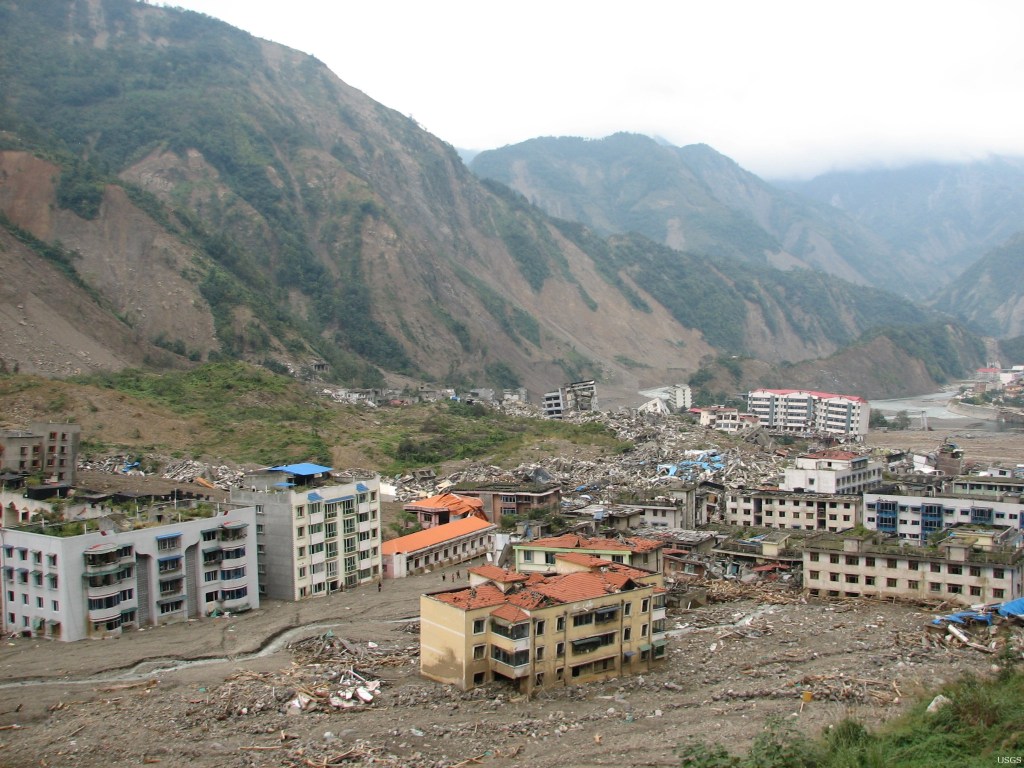
However, when a strong earthquake hits, the delicate equilibrium of the mountain slopes is disturbed so much, that many new landslides can occur at once (we call them the coseismic landslides). During the following years, the slopes will search a new equilibrium.
Some of the coseismic landslides will keep moving for years, for example every time there is a very strong rain. Some others will not move again and will quickly get covered by vegetation, disappearing from the maps.
Some new landslides (the postseismic landslides) will also occur in places where no coseismic landslides were recorded. These often happen on slopes that were damaged by the earthquake, but not enough to fail immediately. Rain, weathering, contribute to their eventual failure.
This is a complex picture of an extremely dynamic environment, that seeks a new equilibrium after a strong disturbance. We demonstrate that, as the mechanisms controlling the activity of the coseismic landslides change with time rather rapidly (generally from a seismic control to a hydrological control) our usual tools for predicting the susceptibility of a landscape to landslides do not work. Instead, we have to update our model every year to obtain reasonable predictions of what is going to happen the following year.
If I intrigued you enough, check our new article in Geophysical Research Letters:
https://agupubs.onlinelibrary.wiley.com/doi/10.1029/2020GL090509
A full text is freely available on ResearchGate:
 The Geohazards Group