
We are excited to share a brand-new research paper, freshly published in Earth Surface Processes and Landforms (ESPL)! The study, led by Dr. Sumit Das (PI of the Coupled Earth Surface Research Group) and co-authored by Gianvito Scaringi, tackles a geomorphic paradox: Why do some rivers carrying massive sediment loads completely fail to build subaerial deltas?
The paradox of the Narmada and Tapi Rivers
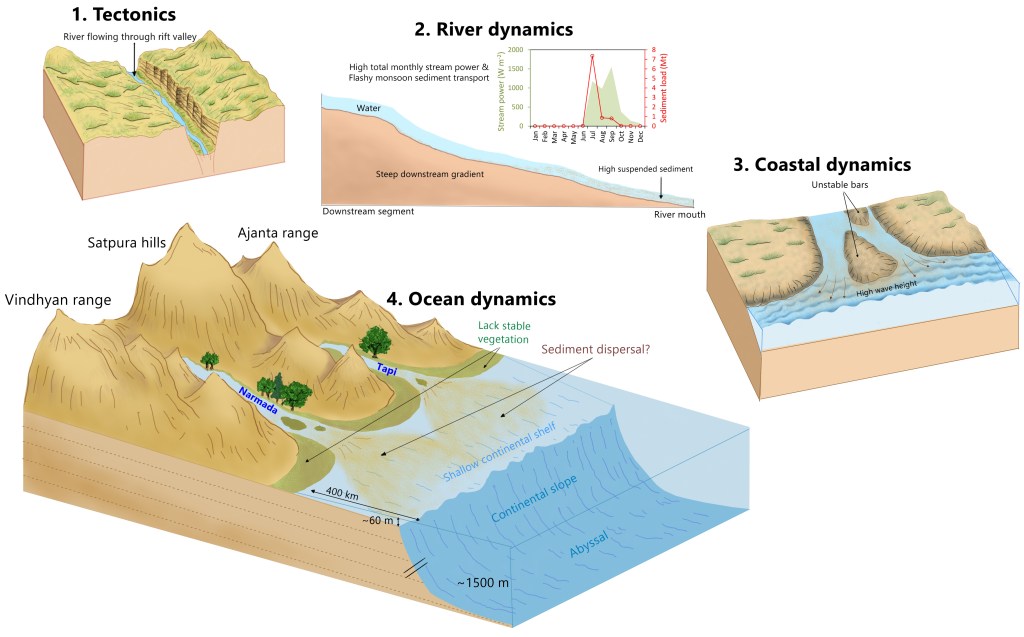
Textbooks teach us that high sediment supply equals delta growth. Yet, the Narmada and Tapi rivers of Peninsular India challenge this fundamental assumption. Together, they dump massive amounts of sediment into the Gulf of Khambhat (Arabian Sea) that rival or easily exceed well-known delta-building systems like the Po or Mahanadi rivers. Despite this immense structural budget, there are no classic protruding delta plains to be found at their mouths. Instead, they maintain stable, tide-dominated estuarine shapes. Through an integrative analysis of tectonic frameworks, river steepness indexes, monsoonal stream power, and offshore bathymetry, our team explored why these systems favor sediment dispersal over retention.
Three core controls limiting delta growth
We identified three major morphodynamic barriers that explain this low sediment retention efficiency:
- Tectonic confinement & missing floodplains
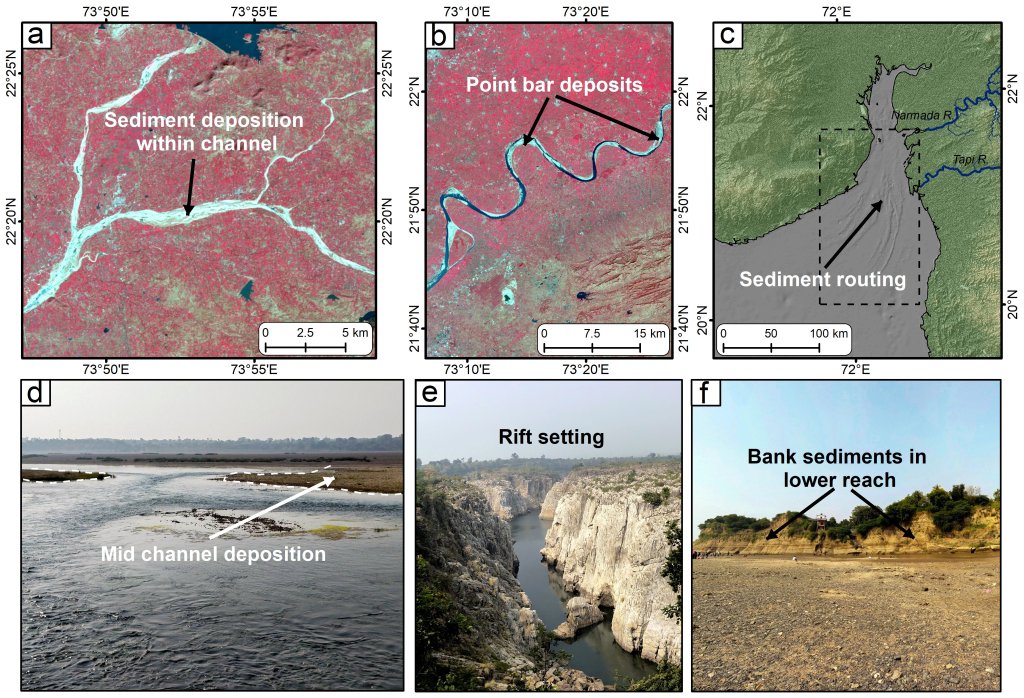
Both rivers flow through the narrow, structurally controlled Narmada-Tapi rift valley system. This structural setup squashes floodplain development near the coast, limiting the physical accommodation space needed for sediment to spread out, settle, and build land. - High monsoonal stream power
Because their flows are dominated by the flashy Indian Summer Monsoon, these rivers generate tremendous unit stream power during peak discharge. This high energy keeps massive quantities of sediment suspended in the water column, washing it directly past the river mouth rather than allowing it to drop out and form mouth bars. - A high-energy marine “vacuum”
Once the sediment reaches the coast, it encounters the macro-tidal environment of the Gulf of Khambhat. Strong, bidirectional tidal currents sweep across a broad, topographically complex continental shelf, efficiently dispersing and exporting the sediment offshore into the deeper Arabian Sea.
Moving beyond sediment supply
Stratigraphic records analyzed in the paper show that while these rivers achieved a brief phase of delta-like progradation in the late Holocene, subsequent tectonic uplift and changing conditions triggered river incision, completely erasing the nascent delta plain.
Ultimately, the paper argues that the absence of a delta isn’t a sign of sediment limitation. Instead, the Narmada and Tapi represent a stable, morphodynamically constrained end-member of high-energy coastal systems.
Why this matters: As we look to assess delta sustainability under future climate change and human modifications worldwide, this study emphasizes that we must move beyond tracking sediment supply alone. If a coastal system’s structural and hydrodynamic setting dictates a low sediment retention efficiency, throwing more sediment at the coast won’t build land—it will simply bypass it.
Read the full paper
The open-access article contains comprehensive datasets, global river comparisons, and detailed conceptual models. You can read and download the paper directly via the link below:
- Das, S. & Scaringi, G. (2026). Low sediment retention efficiency limits delta formation in tectonically confined high-energy coastal systems. Earth Surface Processes and Landforms, 51(6), e70304. https://doi.org/10.1002/esp.70304
 The Geohazards Group