
The draft state budget for 2027 leaves no money for a new call of ERC-CZ, one of the most effective research funding schemes in Czechia. Together with the Junior Faculty initiative at the Faculty of Science, Charles University, we have launched an open letter asking Members of Parliament to put this right. What we’re asking for is modest: an amendment that adds CZK 150 million a year for 2027–2029 to the budget of the Ministry of Education, Youth and Sports, so that a new call can open.
If you work in research or higher education in Czechia, please take two minutes to sign the letter, and then pass it on to your colleagues.
What ERC-CZ does
The European Research Council (ERC) funds frontier research in every field, and its grants are among the most competitive in the world. Every year, many proposals that the ERC’s panels rate as excellent still go unfunded, simply because the money runs out.
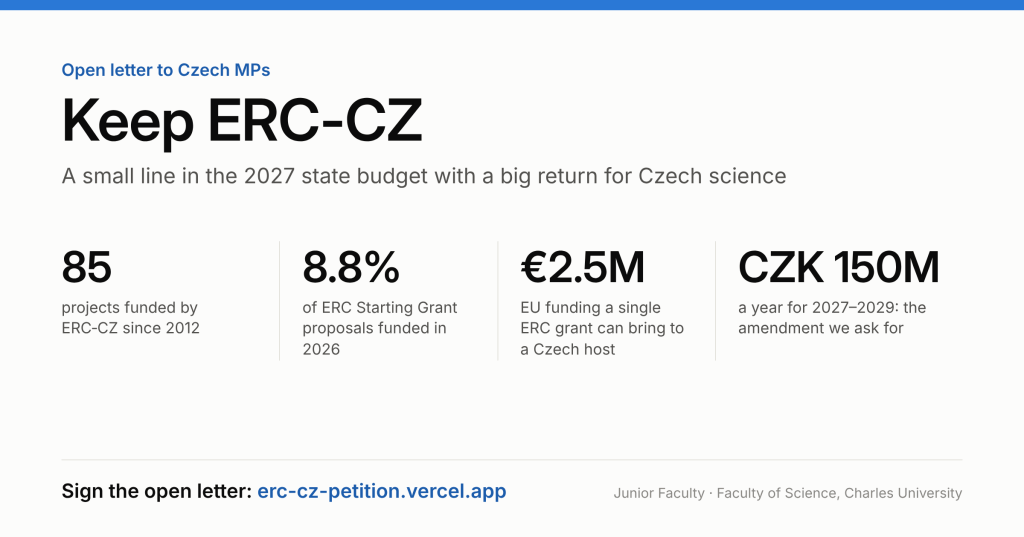
ERC-CZ gives these researchers a second chance. Since 2012, the Ministry has funded projects that applied to the ERC with a Czech host institution, reached the final round of evaluation and missed out only because of the ERC’s budget limits. So far, 85 projects have been supported. Holders must apply to the ERC again, and if they succeed, the national funding stops and the European grant takes over.
Why it matters
ERC-CZ costs the state very little. The selection is done by the ERC’s international panels and paid for by the EU, so the Ministry pays only for the research and its administration. The CZK 150 million a year we’re asking for is less than 0.01% of planned state spending in 2027. In return, every holder who goes on to win an ERC grant brings up to €2.5 million (over CZK 60 million) of European funding to a Czech university or institute. It is a real multiplier!
The programme also helps Czechia keep and attract talent. A researcher deciding where to base an ERC application knows that, with a Czech host, an excellent proposal that the ERC can’t afford to fund still has a second chance. Without ERC-CZ, the best candidates have fewer reasons to choose Czech institutions, and more reasons to leave.
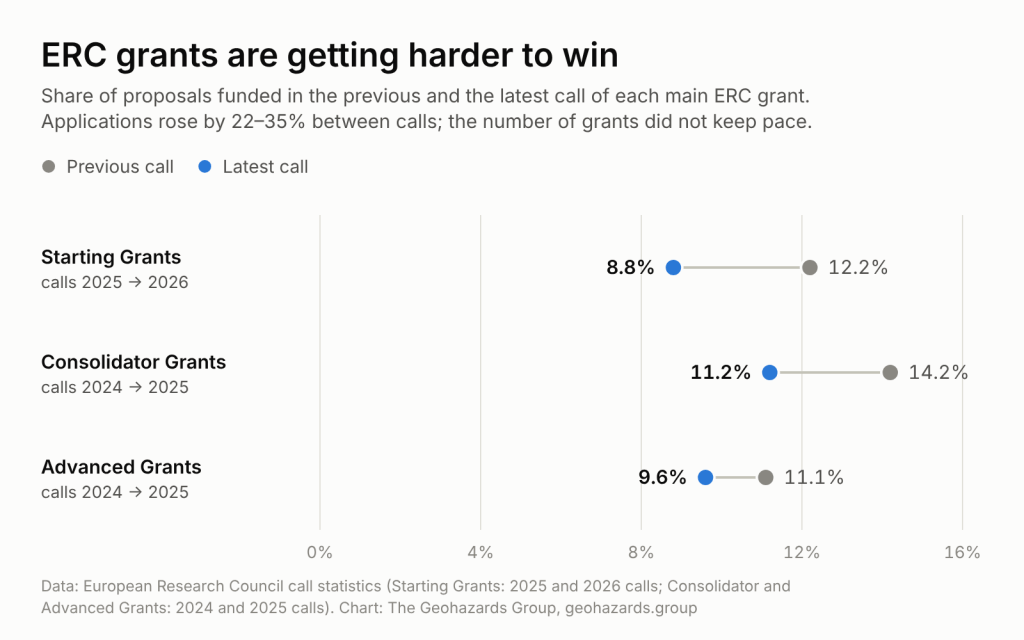
And the timing could hardly be worse. In this year’s ERC Starting Grant call, only 8.8% of the 4,807 proposals were funded, one of the lowest success rates since the ERC’s first call in 2007. The ERC’s work programme for 2027 foresees even fewer Starting and Consolidator Grants, with an expected success rate of less than 5%. Meanwhile, Norway and Portugal have recently set up similar schemes of their own. Czechia, which has had one since 2012, is about to pause it.
What we are asking for
The letter asks MPs to support an amendment, in the second reading of the 2027 state budget, that increases chapter 333 (the Ministry of Education, Youth and Sports) by CZK 150 million a year for 2027–2029. This would allow the Ministry to open a new ERC-CZ call. The Ministry has said that it asked for this money, but that the amount in the draft budget does not allow a call to be announced.
The figure isn’t new, either. When the government extended ERC-CZ to 2032 back in 2023, it planned CZK 150 million a year for the programme from 2027 to 2032.
We aren’t the only ones speaking up. The Learned Society of the Czech Republic has called on the Chamber of Deputies to increase research funding in the Ministry’s budget so that ERC-CZ can continue, and the Věda žije! forum has written to the Minister about the programme.
How you can help
Amendments can only be tabled in the second reading, which is due in the coming weeks. So please don’t wait:
- Sign the open letter. Signatures are checked before they appear on the site, and email addresses are used only for verification.
- Share it with colleagues in your department, faculty or institute, and on social media.
- If you’re in touch with an MP, draw their attention to the letter.
Like most research groups in Czechia, ours depends on competitive grants, and we know how much it matters to be able to aim high from a Czech institution. ERC-CZ is a small line in a very large budget. For the researchers it supports, and for the institutions that host them, it makes a real difference. Letting it lapse would save very little and cost Czech science a great deal.

